



By Bohdan Vasylkiv
- CEO & Co-Founder
What Is an MVP in Software Development? A Complete Guide
Learn what an MVP (minimum viable product) is in software development - its meaning, benefits, real examples, costs, and 6 steps to build one that wins.
Key Takeaways
- An MVP is the smallest version of your product that still delivers real value to users.
- Building one lets you test demand and gather feedback before spending your full budget.
- The biggest names in tech, from Dropbox to Uber, started as scrappy first releases.
- Skipping validation and overbuilding are the two mistakes that sink most early products.
Every founder knows the fear. You believe in an idea, you have a rough budget, and you dread spending a year building something nobody wants. That fear is exactly what an MVP is designed to kill.
Here's the thing: you don't need the finished product to learn whether people will pay for it. You need enough of it to put in front of real users and watch what they do.
This guide gives you a plain answer to what is mvp in software development, how it differs from a prototype, what it costs, and the six steps we use to ship one. You'll also see how the products you use daily started with almost nothing.
MVP Meaning: What 'Minimum Viable Product' Really Stands For
Before we talk process and price, let's settle the vocabulary. The term gets thrown around loosely, and half the confusion in early product teams comes from people using it to mean different things. The MVP definition most teams find useful is short: the smallest release that lets you learn the most.
What an MVP Is - and What It Definitely Isn't
A minimum viable product carries just enough features to satisfy your first users and, crucially, to teach you something. It solves one real problem well. Everything else waits.
That word "viable" does a lot of work. A viable product actually functions in the hands of a paying user. It isn't a slide deck, and it isn't a half-broken shell you're embarrassed to show. Simply put, the clearest meaning of MVP in software development is a real, working slice of your vision that people can use today.
People often search for the acronym itself, and the MVP full form in software development is exactly what those three letters suggest. The two words that carry the weight are minimum, meaning scope, and viable, meaning quality. You trim the feature list, and you never trim the standard. That single distinction quietly settles most of the arguments a young team has about what to build.
The Three Pillars of a Real MVP: Viable, Usable, Valuable
Hold your first release against the 3 pillars. Miss any one, and the whole thing wobbles, which is really what does MVP mean in software development in practice.
Viable comes first. The product has to work reliably at the one job it promises. The MVP definition in software development hinges on this: a food delivery app that takes orders but loses half of them isn't viable; it's a demo with a marketing budget.
Usable is next. People should figure out your product without a manual. Clean flows beat clever features, because a confused user churns before they reach your value.
Valuable ties it together. Someone has to want the outcome enough to return, tell a friend, or pay. This is where the real benefits of MVP in software development show up, because a valuable slice pulls users in even when the edges are rough.
MVP vs. Prototype vs. Proof of Concept: Drawing the Line
These 3 terms get swapped around constantly, and mixing them up wastes real money. Once you grasp the MVP meaning in software development, the next job is telling it apart from its cousins. Each answers a different question.
A proof of concept asks: Can this even be built? It's an internal experiment, often throwaway code, meant to test a technical assumption. Nobody outside the team touches it.
A prototype asks: what should this feel like? It's usually a clickable mockup showing the flow without real functionality underneath. You use an MVP prototype to gather feedback on the experience before you write production code, and treating that mockup as the finished product is a common trap.
An MVP asks: Will people use and value this? It ships. Real users, real data, real feedback. That's why the whole MVP development process orbits around it, and why getting the flow right tells you exactly when to move from concept to prototype to a live product.
Why Founders Bet on an MVP First
Seasoned founders default to this approach because it lowers the two things that kill young companies fastest: wasted money and wasted time. Knowing what is MVP in software development is one thing, but seeing why to build one is what changes how you spend.
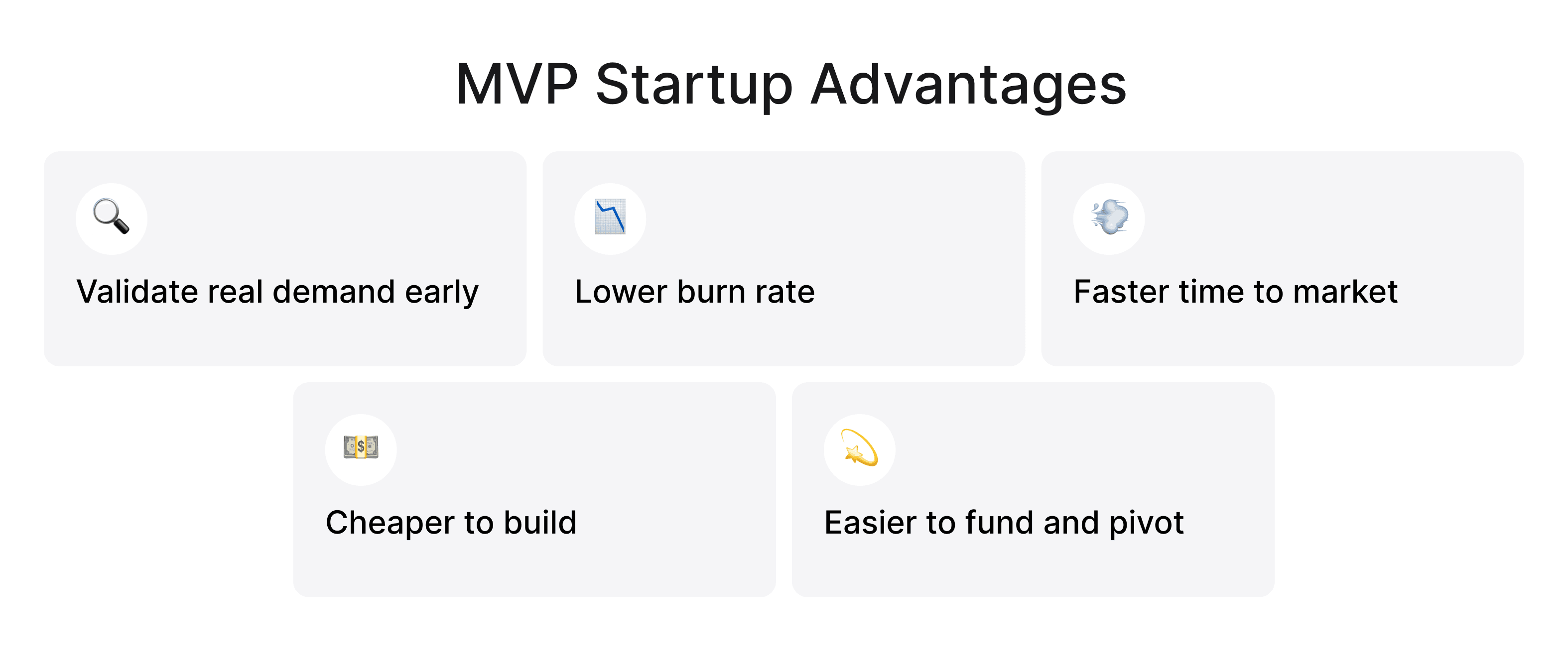
Validating Real Demand Before You Overbuild
The most expensive mistake in software is building something beautiful that nobody needs. Shipping the core early replaces guesses with evidence: you learn whether people click, sign up, return, and pay before committing your full runway.
This matters in MVP app development, where it's tempting to chase a long list of features to match competitors. Resist that. Ship the one thing your users truly need, then let their behavior tell you what to build next.
Every early release is a question you ask the market, and the answer beats any internal roadmap debate. That kind of validation is where the MVP in software development earns its reputation, because real behavior costs a fraction of what a full build would.
Cutting Burn Rate and Reaching the Market Faster
Speed is a feature. The sooner you're alive, the sooner you're learning, earning, and adjusting. A focused first release takes a fraction of the time a full product would.
Fewer features mean fewer hours, and fewer hours mean a smaller bill. Being first also wins early adopters who stick around as you grow.
That combination is why the MVP for startups has become standard advice. When the runway is tight, you can't build for a year on faith. If you want the numbers, we break them down in our piece on how much it costs to build an app.
 Click to expand
Where MVPs Go Wrong (and How to Stay Safe)
The approach has traps. The most common is confusing "minimum" with "sloppy." A viable product still has to work well at its one job, so cut scope and hold your quality bar.
The opposite trap is quietly stuffing the release with extras because each feels essential. Every added feature delays launch and muddies your signal, so discipline about MVP features separates a clean test from an expensive mess.
The third trap is a weak foundation. Tools that suit a tiny app can crack under growth and force a painful rebuild. Our article on the major advantages of an MVP covers the upside in full.
From Idea to Launch: How Incora Ships an MVP in 6 Steps
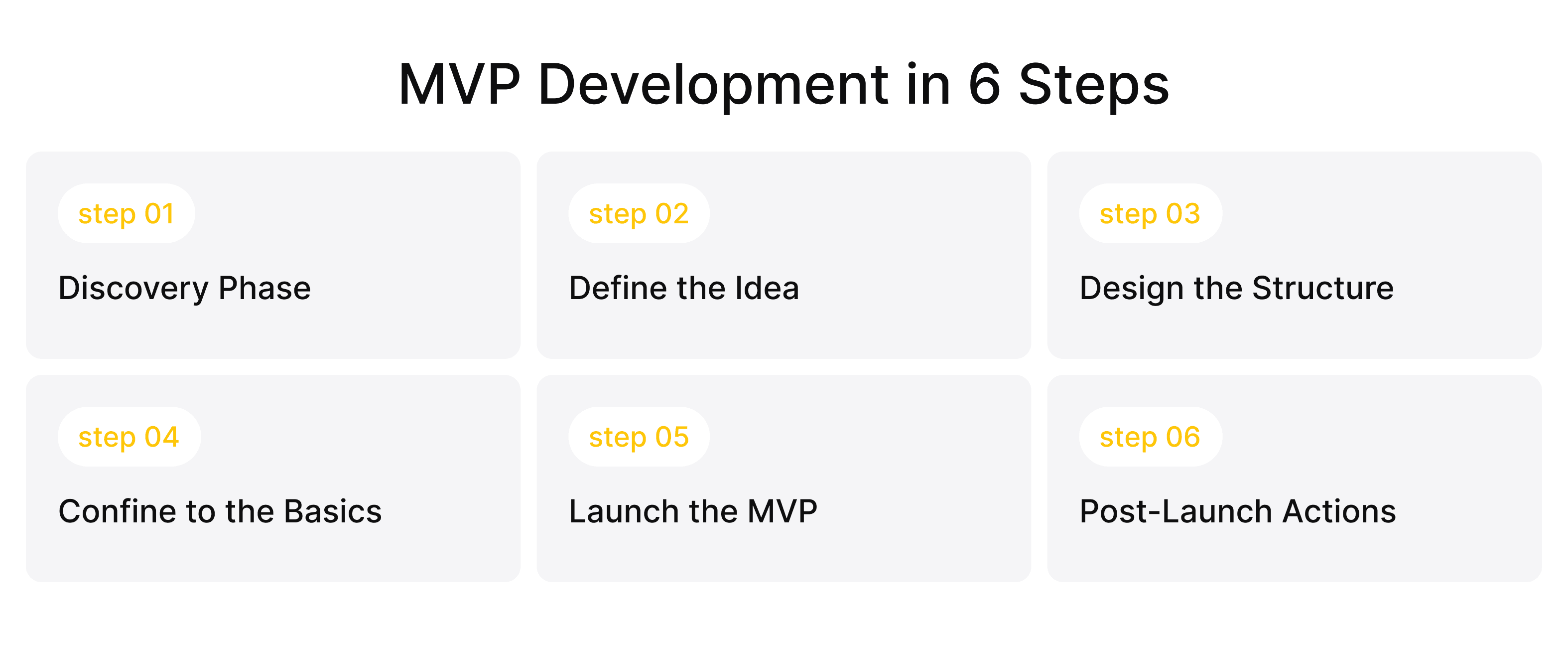
Every team has its own rhythm, but the backbone rarely changes. This 6-step MVP development process is the sequence we follow at Incora, refined across dozens of builds. Treat it as a checklist you can adapt.
Step 1: Discovery Phase of Project
Everything starts with the problem and the people who have it. Before a line of code, validate that demand is real through surveys, interviews, market research, and a hard look at competitors.
Study rivals closely, note where they leave gaps, and aim straight at the openings they've missed. This is where you sketch the MVP concept in software development, you're testing, so the whole team shares one picture of success. As of 2026, discovery leans on real usage data and quick landing-page tests, which makes early signals cheaper than ever.
Step 2: Define the Startup Development Idea
Sharpen your research into one clear statement of value. What do you solve, for whom, and why is your version better than what's already out there?
Lock your priorities, and if you need extra hands, bring in the right people. Whether you hire in-house or reach for a team extension to fill specific gaps, make sure everyone shares your vision and can keep pace.
 Click to expand
Step 3: Design a Structure of Startup
Now shape how the product works. Good UI and UX should drive these decisions, because the smoothest path to your core feature keeps early users around.
Map how someone moves through the product, where they hit value, and where they might pay. Simple flows pay off twice: users get it faster, and you read what's working more clearly.
Step 4: Confine to the Basics
Discipline earns its keep here. List every feature you can imagine, then cut hard to the few that deliver your core promise. A helpful filter: separate what your user needs from what they merely want.
Pile on too many extras too early, and you blur the purpose. If you're building an MVP web development project, that restraint matters even more, since web scope creep is easy and quietly costly.
Step 5: Launch an MVP Software Development
Once the core features are agreed and the signals are clear, build and ship. Remember that an MVP is a smaller product, and it still has to meet real user needs at full quality.
Make it simple, pleasant, and relevant. This build stage is usually the most time-consuming part, so stay close to your MVP prototype and keep your goals in sight. Getting it into real hands is the whole point.
Step 6: Post-Launch Actions
Launch is the start of the real work. Now you listen: gather feedback, watch how people behave, and let that data shape what comes next.
Keep the loop tight and repeat it: learn, measure, adjust. That habit turns a modest first release into a product people love. If you're mapping the earliest moves, our guide on launching an app startup walks through the practical steps.
What an MVP Actually Costs - and What Drives the Price
Almost every article promises that an MVP saves money, then stops there. Let's be concrete. Cost comes down to three levers: how many features you build, how complex they are, and the hourly rate of whoever builds them.
Rates vary widely by region. A senior developer in North America can cost several times more per hour than an equally skilled engineer in Eastern Europe, which is why so many companies build there. In MVP app development, scope is almost always the biggest cost driver, not the rate.
Most MVPs land between $15,000 and $100,000 as of 2026, depending on scope and complexity. A simple single-purpose app sits near the bottom; something with payments, real-time features, and multiple user types climbs toward the top. A disciplined build often ships in two to three months instead of four to seven, cutting the bill roughly in half.
Wondering what your MVP would actually cost to build?
Tell us what you have in mind, and we'll help you scope the smallest version worth shipping.
MVPs That Grew Into Giants: 5 Products That Started Small
Theory is nice, but proof is better. Some of the most valuable companies alive started with an embarrassingly small first version. Here are 5 MVP examples worth learning from, and what each got right.
Dropbox: A Demo Video as the Whole Product
Dropbox skipped building at first. Instead of engineering a full file-syncing system, the founders made a short demo video showing how it would work. That was the test.
Sign-ups jumped overnight, proving people wanted effortless syncing before a single server was provisioned. It's one of the cleanest minimum viable product examples around: sometimes the cheapest way to validate demand is to fake the product convincingly and count who raises a hand.
Airbnb: Three Air Mattresses and a Landing Page
Airbnb began in the founders' own apartment. Short on rent, they put three air mattresses on the floor, built a bare landing page, and offered travelers a cheap place to crash during a busy conference.
Strangers paid. That signal, real people choosing a stranger's floor over a hotel, proved the core idea. Their minimum viable product answered one question before any platform existed: Will people do this at all?
 Click to expand
Uber: One City, One Tap to Ride
When it launched in 2009, Uber, then UberCab, connected drivers with riders in a single city, San Francisco, through an iPhone app and SMS. That was the whole product.
It was enough to prove demand for cheap, on-demand rides. Drivers signed up, riders tapped, and the early app's data showed the founders exactly what worked. That evidence, not a grand plan, fueled the expansion into the company you know now. One city and one clear function gave them a signal strong enough to build a global business on.
Instagram: Stripping Burbn Down to Photos
Instagram didn't start as Instagram. It began as Burbn, a cluttered check-in app packed with features nobody used. The founders studied the data and noticed one thing users loved: sharing photos.
So they cut everything else and relaunched around photos, filters, and likes. That single decision turned a struggling product into one of the fastest-growing apps ever. The lesson is uncomfortable but useful: your best product might be hiding inside your bloated one, waiting for you to delete the rest and pay attention to what people already love.
Spotify: Betting Everything on One Feature
Spotify launched with a laser focus on one promise: instant, reliable streaming with no lag. In an era of clunky downloads, that alone felt like magic.
The early version was invite-only and stripped back, but the core experience was flawless. It's a textbook case of MVP in software development done right: nail one thing people crave, and you earn the right to build the rest later.
5 MVP Mistakes That Quietly Kill Early Products
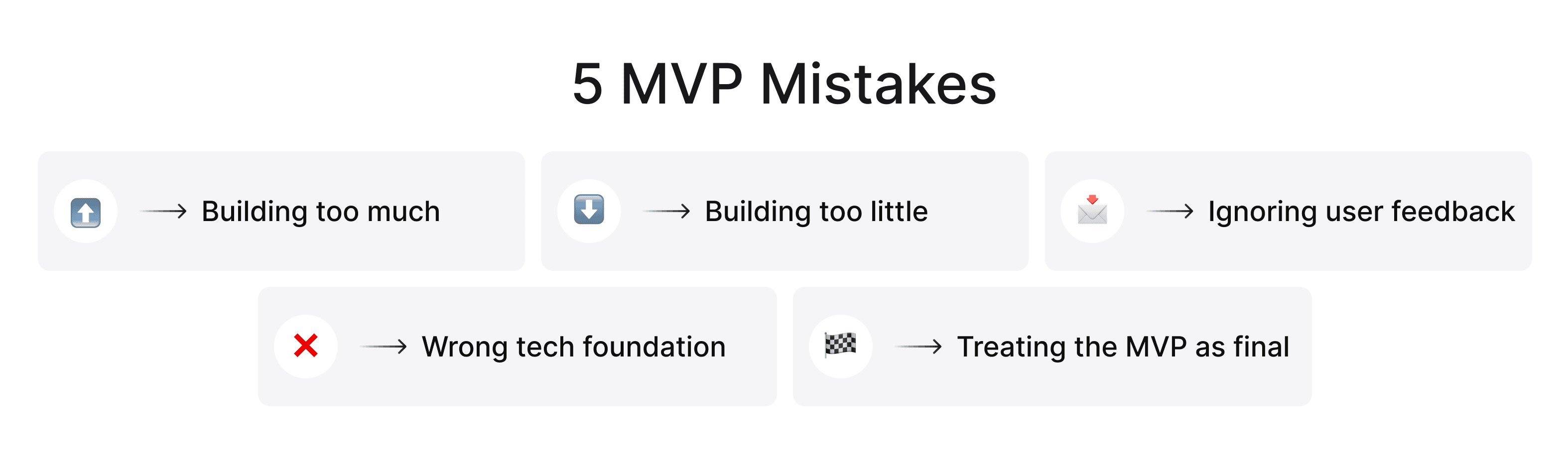
Most MVPs don't fail loudly; they fizzle from quiet, avoidable errors. Since what is MVP in software development comes down to disciplined learning, these five mistakes all work against that discipline.
First, building too much. A bloated first release defeats the purpose and burns your budget before you've learned anything.
Second, building too little. Strip away so much that a minimum viable product no longer solves a real problem, and users simply shrug. Viable has to stay in the name.
Third, ignoring feedback. Some teams ship, fall in love with their roadmap, and stop listening. The market's response is the entire reason you launched small.
 Click to expand
Fourth, the wrong tech foundation. Tools that fit a toy app buckle under real growth, forcing a rebuild that costs more than doing it right the first time.
Fifth, treating the MVP as final. It's a learning tool, not a destination. Teams that never iterate freeze at version one while competitors pass them.
Is an MVP the Right Move for Your Product?
By now, the answer to what is MVP in software development should be clear, but knowing the definition and knowing whether you need one differ. For new or unproven ideas, the answer is usually yes.
It's a strong fit when your budget is limited, when speed matters, or when you're entering territory nobody has mapped. It's less essential when you build to a fixed, well-understood spec, like an internal tool with known requirements and no demand risk. Understanding what does MVP mean in software development helps you judge which case you're in.
Ask 3 questions. Do I truly know people want this? Can I afford to build the full thing on faith? Is being early worth more than being complete? If the answers lean toward doubt or a tight budget, an MVP is your smartest first step.
Knowing When to Graduate From MVP to Full Product
An MVP has a job, and once it's done, clinging to it holds you back. The point of MVP in software development is to learn, so the question becomes whether you've learned enough to grow up.
The clearest signal is consistent demand. When users keep returning, ask for features that extend your core value, and your metrics trend up, the market is telling you the idea works. Watching that shift is central to the MVP meaning in software development: proof beats opinion.
Feedback changes tone, too. Early on, people question whether they need you at all; later, they request specific improvements and polish. And if your lean stack strains under real traffic, that's growth pressure, and a good problem. A minimum viable product graduates on evidence, not hope.
Building Your MVP With Incora
Here's what we've learned after shipping MVPs across many industries: the hard part isn't the code, it's the judgment. Knowing what to cut, what to keep, and which foundation won't box you in later is where most of the value lives.
That's the work our team does every day. Incora builds custom MVPs that stay lean without cutting corners, and helps you choose a tech stack that scales when your product takes off. If you'd rather move fast without hiring a full internal team, our MVP development services cover the build end-to-end, while our startup product development practice takes founders from raw idea to a product ready to grow.
The goal is always the same: get you to real users quickly, with something worth their time, so the market can tell you what to build next.
Not sure where to start with your MVP?
Book a quick call, and we'll walk you through what's possible for your business.
Final Takeaway
Build the smallest version that delivers real value, learn from real users, and grow from evidence instead of assumptions. That's the whole MVP definition in one sentence. The biggest companies of the last two decades started this way, and the logic holds just as well in 2026. Start small, stay honest about quality, and let your users draw the map.
FAQ
What is the full form of MVP in software development?
The full form of MVP in software development is "minimum viable product." In plain terms, that's the smallest working version of your product that still delivers real value and teaches you something about your users.
What's the difference between an MVP and a prototype?
A prototype shows how a product will look and feel, usually as a clickable mockup with no real engine underneath. An MVP is a working product that real users actually use. You often build the prototype first, then turn the validated design into a live MVP. The prototype answers "does this feel right?" while the MVP answers "will people use and pay for this?"
How do you choose which features go into an MVP?
Start from your core value. Ask what single problem you solve, then keep only the features that serve it directly. A simple test: separate what users need from what they'd merely like. If a feature doesn't support the main promise, it waits for later.
How much does it cost to build an MVP?
Most MVPs cost between $15,000 and $100,000 as of 2026, depending on scope, complexity, and where your team is based. A simple single-feature app sits at the low end, while a platform with payments and multiple user types runs higher.
How long does it take to build an MVP?
Usually 2 to 3 months, though it depends on complexity. A full product might take 4 to 7 months, so an MVP roughly halves that. The fewer features you commit to at launch, the faster you reach real users.
When should you move from an MVP to a full product?
When the evidence is consistent: steady demand, users returning on their own, requests for deeper features, and metrics trending up. When your lean setup strains under real traffic, that's growth pressure too. Together, those signals mean it's time to invest in scale.


YOU MAY ALSO LIKE




Get in Touch

Just pick a time. No forms.


This site uses cookies to improve your user experience. Read our Privacy Policy
Accept